



Copper Microchannel Heat Sink with CNC Precision Machining
Category:
Key Words:
Product parameters
Parameter | Specification / Range |
Product Name | Copper Microchannel Plate / CNC Cooling Plate / Microchannel Heat Sink |
Material | Copper (C1100 / C1020) / Copper Alloy (optional) |
Manufacturing Process | CNC Machining / Milling / Drilling / Finishing |
Structure Type | Microchannel / Slot Channel / Custom Flow Design |
Plate Thickness | 2 – 50 mm (customizable) |
Channel Width | 0.2 – 2.0 mm (depending on design & tool) |
Channel Depth | 0.5 – 10 mm (customizable) |
Channel Pitch | 0.3 – 3.0 mm |
Surface Roughness | Ra 0.8 – 3.2 μm (machined) |
Flatness | ≤ 0.05 mm (depending on size) |
Tolerance | ±0.01 – ±0.05 mm |
Surface Treatment | Cleaning / Polishing / Nickel Plating / Anti-oxidation |
Sealing Method | Brazing / Welding / Cover Plate Assembly (if required) |
Cooling Medium | Water / Coolant / Customized fluids |
Thermal Performance | High heat transfer efficiency (design dependent) |
Operating Temperature | -40°C to 200°C (depending on application) |
Pressure Resistance | Based on design (customizable) |
Application | Liquid Cooling / Heat Sink / Heat Exchanger / Thermal Management |
OEM / ODM | Supported |
Drawing Format | STEP / STP / IGES / CAD / PDF |
Sample | Available |
Lead Time | 10 – 25 days |
Packaging | Anti-oxidation packaging / Custom export packaging |
Product Description
Product Description
Copper microchannel heat sink manufactured with CNC precision machining, designed to enhance thermal management performance. The integrated microchannel structure increases heat exchange efficiency and improves cooling capability compared with traditional heat sinks.
Application Field
Electronic devices requiring copper heat sinks for thermal management
High-density systems using microchannel heat sinks
Power modules and equipment with CNC machined cooling sinks
Industrial applications needing efficient heat dissipation solutions
Precision CNC Machined Copper Microchannel Heat Sink with ±0.01mm Tolerance
In the realm of advanced thermal management, the efficiency of a cooling system is often dictated not just by the material used, but by the precision of its geometry. For high-performance applications ranging from semiconductor manufacturing to laser diode cooling, the margin for error is non-existent. Our Copper Microchannel Heat Sink with CNC Precision Machining represents the pinnacle of thermal engineering, where strict tolerance control meets superior material science to deliver unmatched cooling performance.
The Critical Role of 5-Axis CNC Machining
Creating effective microchannels requires more than just removing material; it requires an intricate understanding of tool paths, cutting forces, and material behavior. At our facility, we employ advanced 5-axis CNC machining centers to manufacture complex heat sink geometries that are impossible to achieve with traditional 3-axis milling or extrusion.
The primary advantage of 5-axis machining is the ability to approach the workpiece from virtually any direction. This allows us to machine deep, narrow microchannels and intricate manifold structures in a single setup. By minimizing setup changes, we significantly reduce the risk of cumulative errors, ensuring that the internal cooling channels align perfectly with the external mounting interfaces. This capability is essential for producing a CNC Precision Heat Sink that meets the rigorous demands of modern high-heat-flux applications.
Mastering Tolerance: The ±0.01mm Standard
When we speak of a Microchannel Machining Tolerance of ±0.01mm, we are referring to the consistency and accuracy of every critical dimension of the heat sink. In microchannel applications, the width, depth, and pitch of the fins directly influence the hydraulic diameter and the Reynolds number of the coolant flow.
If the tolerance drifts even slightly, it can lead to uneven flow distribution. Some channels might receive more coolant than others, creating "dead zones" where heat builds up. Our precision machining process ensures that:
- Channel Width Consistency: Every channel maintains the exact designed width, ensuring uniform fluid velocity.
- Fin Integrity: The thin copper fins between channels remain straight and robust, preventing collapse under high pressure.
- Base Flatness: The mating surface is machined to a mirror-like flatness, minimizing the thermal interface material (TIM) thickness and reducing thermal resistance.
CNC Machining vs. Stamping: Why Precision Matters
While stamping and extrusion are viable for mass-producing simple heatsinks, they fall short when it comes to high-performance microchannel structures, especially in copper.
Surface Finish and Thermal Contact
One of the most significant advantages of our CNC process is the surface finish. Stamped parts often suffer from burrs, uneven surfaces, and "spring-back" effects that compromise the flatness of the base. In contrast, our CNC-machined heat sinks achieve a surface roughness of Ra ≤ 0.8μm without the need for extensive secondary polishing. A smoother surface ensures maximum contact area with the heat source (such as an IGBT module or CPU), facilitating faster heat transfer.
Complexity without Compromise
Extrusion is limited by the die profile; you cannot create closed loops, varying channel depths, or interrupted surfaces. CNC machining allows for total design freedom. We can incorporate stepped channels—wider inlets to reduce pressure drop and narrower micro-fins in the heating zone—to optimize thermal performance dynamically.
Material Selection: Copper for Maximum Conductivity
While aluminum is easier to machine, our focus on Copper Microchannel Heat Sinks is driven by the need for maximum thermal conductivity. Copper (C11000/C10200) offers a thermal conductivity of ~400 W/m·K, nearly double that of aluminum. However, copper is also gummy and prone to deformation during machining.
To counter this, our engineers utilize specialized tooling strategies:
- High-Speed Machining (HSM): We use high spindle speeds with lower cutting forces to prevent the copper from deforming under pressure.
- Sharp, Coated Tooling: We utilize diamond-coated or specialized carbide end mills to ensure clean cuts and prevent material tearing.
- Thermal Control: We manage the heat generated during cutting to prevent the workpiece from expanding and distorting, ensuring the final dimensions remain within the ±0.01mm target even after the part cools.
Performance Impact: How Tolerance Affects Efficiency
The relationship between machining tolerance and cooling efficiency is direct. A ±0.01mm Copper Sink ensures that the hydraulic resistance across all parallel channels is identical.
Feature | Impact on Performance |
|---|---|
Uniform Channel Depth | Ensures equal flow rate across the entire heat sink, preventing hot spots. |
High Aspect Ratio Fins | Increases the surface area available for convection without increasing the footprint. |
Precision Manifold Integration | Allows for direct integration of inlet/outlet ports, reducing leak points and assembly complexity. |
Visualizing Precision: Quality Assurance
We don't just claim precision; we verify it. Every batch of heat sinks undergoes a rigorous quality control process. We utilize Coordinate Measuring Machines (CMM) to verify channel dimensions and surface profilometers to check roughness.
For our microchannel products, we often provide microscopic imaging of the channels to our clients. This visual proof confirms that the internal structure is free of burrs, debris, and deformation. This level of scrutiny is why our components are trusted in industries where failure is not an option, such as medical imaging and aerospace electronics.
Technical Specifications
- Material: High-Purity Copper (C11000, C10200, T2)
- Machining Tolerance: ±0.01mm on critical features
- Surface Finish: Ra ≤ 0.8μm (milled), Ra ≤ 0.4μm (polished)
- Min. Channel Width: 0.5mm (CNC), <0.5mm (via etching)
- Max. Part Size: 600mm x 400mm (varies by geometry)
- Inspection: CMM Report, Surface Roughness Test, Leak Test
Request a Quote for Precision Thermal Solutions
If your project demands the highest level of thermal performance and geometric accuracy, our CNC machined copper heat sinks are the ideal solution. We combine advanced 5-axis technology with rigorous quality control to deliver parts that meet your exact specifications.
Contact us today to discuss your custom thermal requirements.
Luna
WhatsApp: 12132219094
Questions and Answers
Frequently Asked Questions (FAQ)
Q1: Why is ±0.01mm tolerance necessary for a heat sink?
In microchannel heat sinks, the coolant flow must be evenly distributed to maximize heat transfer. If the channel dimensions vary by more than a few hundredths of a millimeter, the fluid will take the path of least resistance, bypassing some areas and causing hot spots in others. A tolerance of ±0.01mm ensures uniform flow and consistent cooling performance.
Q2: Can you machine complex shapes like serpentine channels in copper?
Yes. Unlike extrusion, which is limited to straight profiles, our 5-axis CNC machining allows us to create complex serpentine, spiral, or stepped channel patterns. This is crucial for directing coolant specifically to high-heat zones on the component.
Q3: How does the surface finish of a CNC heat sink compare to a stamped one?
CNC machining produces a significantly superior surface finish. While stamped parts often have burrs and uneven bases that require secondary flattening, our CNC process achieves a flatness of ≤0.02mm and a roughness of Ra ≤ 0.8μm directly off the machine. This ensures optimal contact with your electronic component.
Q4: Do you provide inspection reports for the microchannels?
Absolutely. We understand that precision is key. We can provide CMM (Coordinate Measuring Machine) reports verifying the critical dimensions of the channels and the flatness of the base. For visual verification of the internal structure, we can also provide microscopic images of the channel cross-sections.
Q5: Is copper better than aluminum for CNC microchannel heat sinks?
For high-power applications, copper is superior due to its thermal conductivity (~400 W/m·K vs ~200 W/m·K for aluminum). While copper is harder to machine and heavier, the thermal performance gain is essential for high-heat-flux devices like lasers and high-end CPUs.
Factory Description
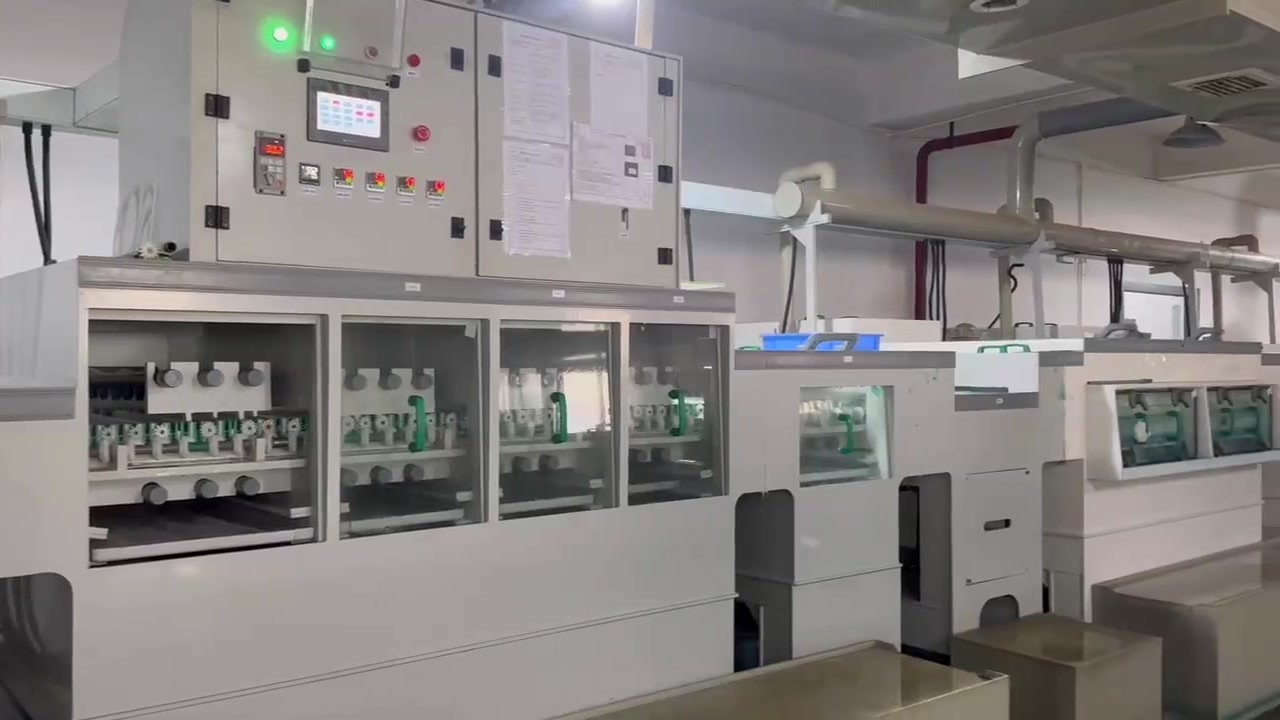
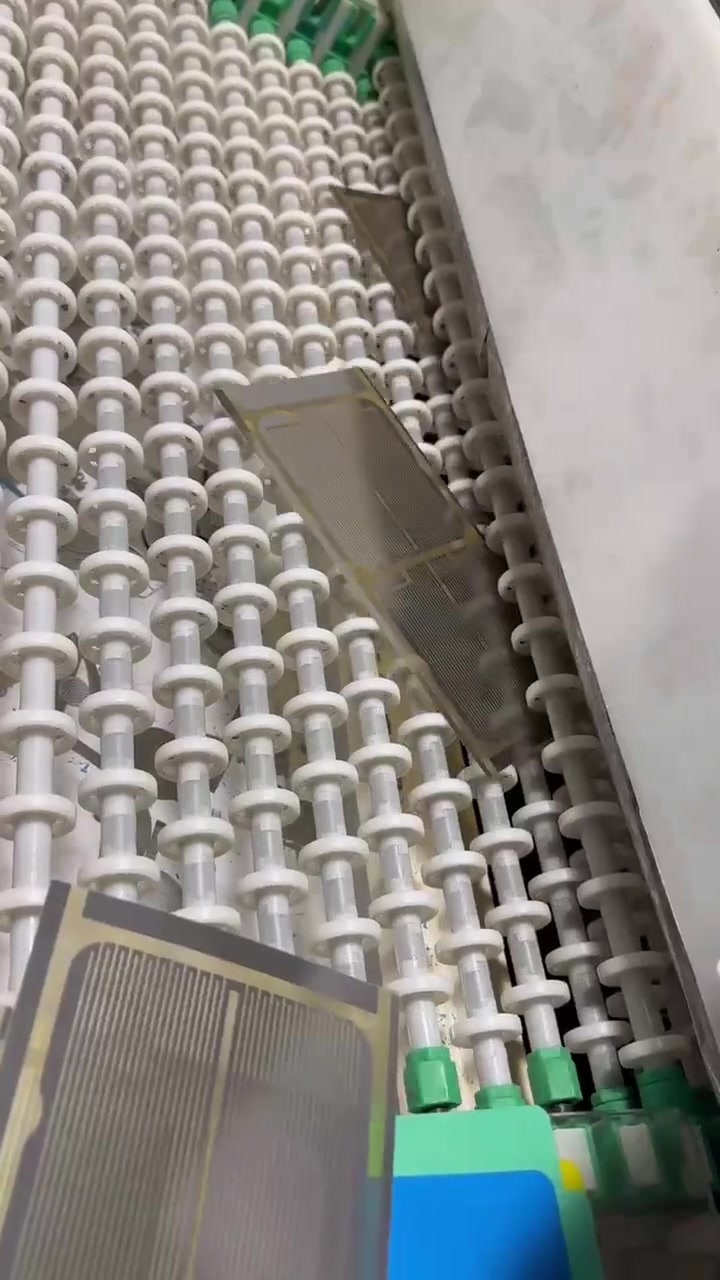
We have a full set of etching production equipment and mature processing technology. We can manufacture products in any shape with mesh sizes as small as 0.1mm, according to your requirements.


Our Advantage
Factory Direct Shipping
Our products undergo 100% QC checks before shipment, and we ensure compliance with international standards. If you require specific certifications for your target market, just let us know, and we'll meet those requirements.
Experienced Design and Manufacturing Team
We work closely with customers from the design phase to help avoid potential product flaws, ensuring both the functionality and design meet expectations.
Excellent Supply Chain Management
We can quickly adjust production schedules to meet your urgent deadlines, whether it's for large bulk orders or smaller rush orders.
OEM & ODM Support
We offer the option to print your logo or other customizations.
Strict Quality Control
Our products undergo 100% QC checks before shipment, and we ensure compliance with international standards. If you require specific certifications for your target market, just let us know, and we'll meet those requirements.
Certificate
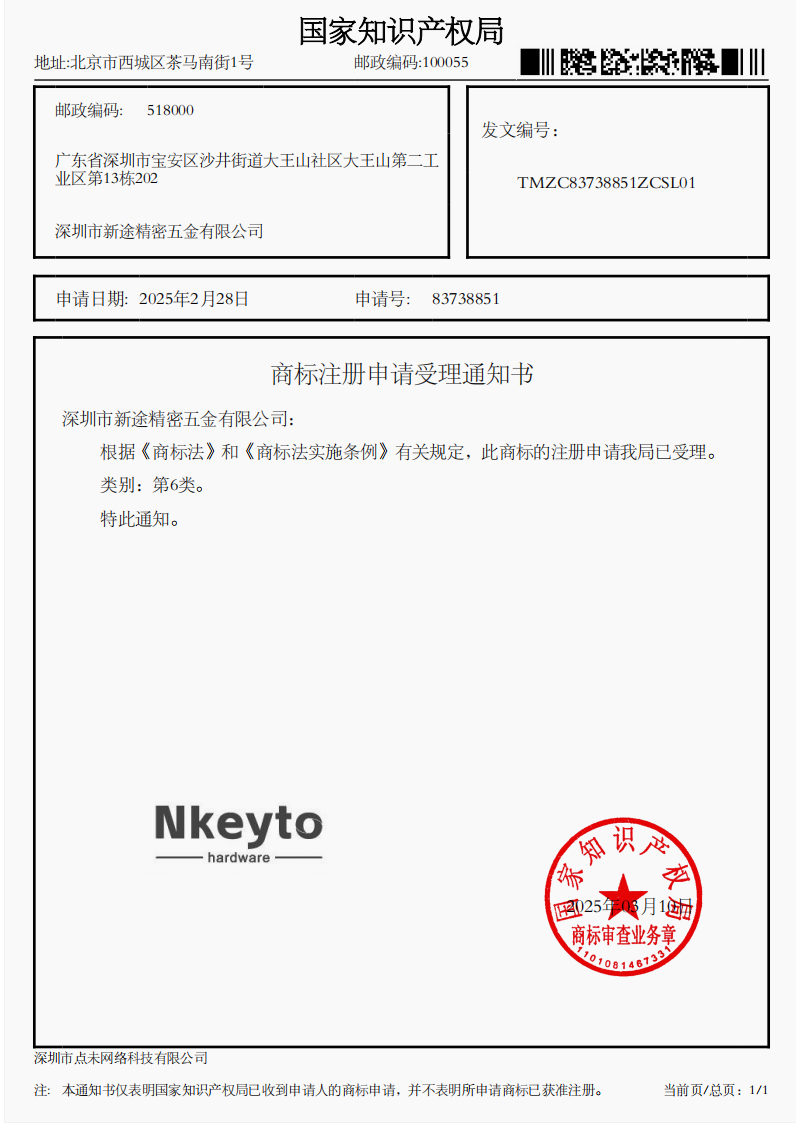
商标6类

9001
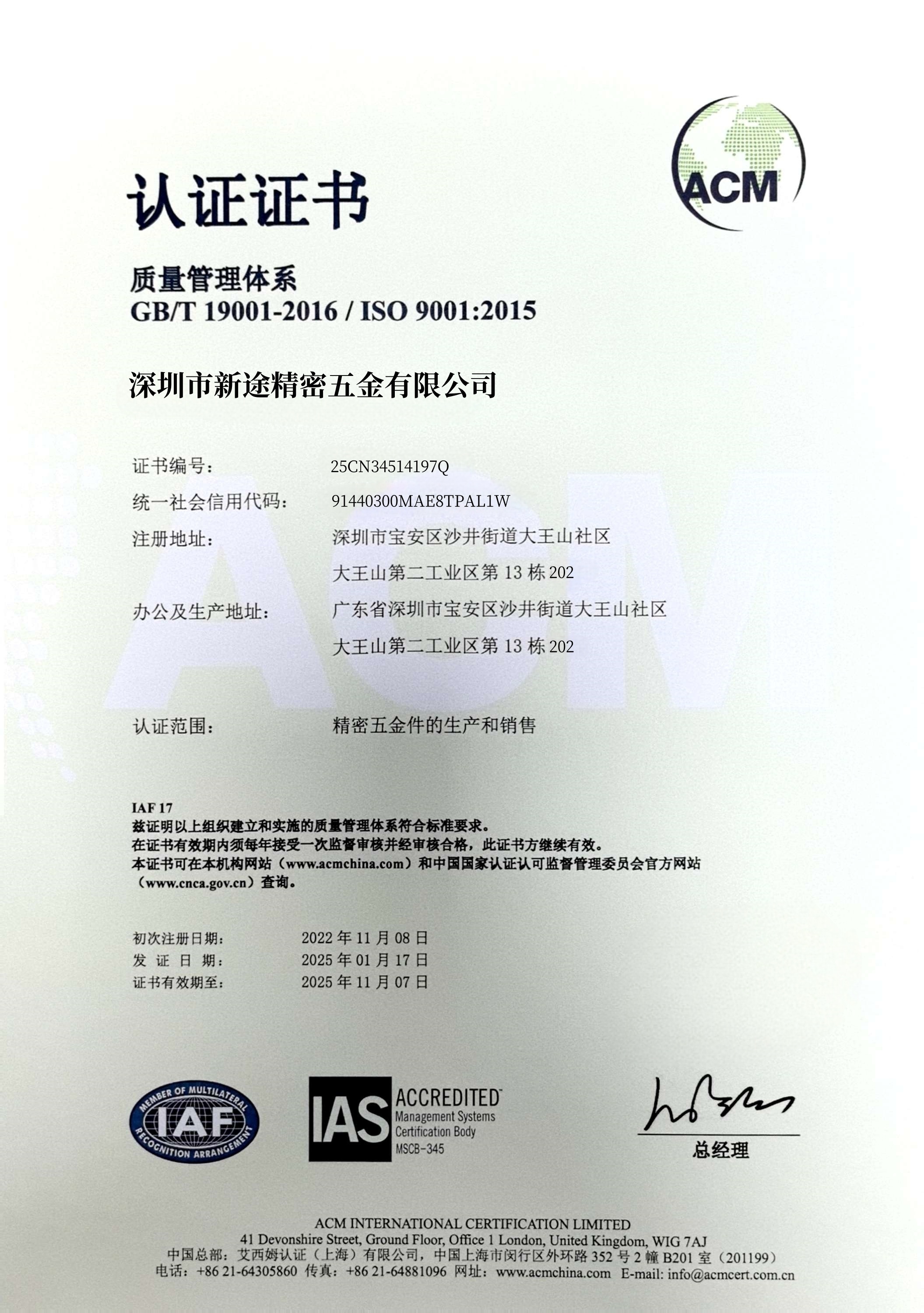
质量认证


Related Products

Shenzhen Nkeyto Precision Hardware Co., Ltd. is a factory specializing in precision hardware processing, committed to providing customers with high-quality products and services.We look forward to working with you.
Contact Us

E-mail: luna@nkeyto.com

Tel: +1 213-221-9094

Add: 13th Building, 202, Dawangshan Second Industrial Zone, Dawangshan Community, Shajing Street, Bao'an District, Shenzhen, Guangdong Province
Powered by: CEglobal
Copryright © 2025 Shenzhen Xintu Precision Hardware Co., Ltd.




Back To Top