



EMI Shield Cover for 5G Module PCB RF Shielding Can
Category:
Key Words:
Product parameters
Parameter | Specification |
Product Name | EMI Shielding Can / RF Shielding Cover / PCB Shielding Can |
Material | Stainless Steel (SUS304 / SUS301), Nickel Silver, Copper |
Thickness | 0.05 mm – 0.30 mm |
Manufacturing Process | Chemical Etching + Stamping + Bending |
Surface Treatment | Tin Plating / Nickel Plating / Gold Plating / Natural Finish |
Shielding Effectiveness | 30 dB – 90 dB (depending on design & frequency) |
Frequency Range | MHz – GHz |
Dimensional Tolerance | ±0.01 – ±0.03 mm |
Flatness | ≤ 0.05 mm |
Hole Size | ≥ 0.03 mm (etching dependent) |
Structure Type | One-piece / Two-piece (Frame + Cover) / Clip Type |
Mounting Method | SMT Soldering / Through-hole / Clip-on |
Edge Condition | Burr-free (etching process) |
Operating Temperature | -40°C to 300°C (depending on material) |
Corrosion Resistance | High (optional plating for enhanced protection) |
Application Level | PCB Level / Module Level Shielding |
Customization | Size / Thickness / Hole Pattern / Structure / Surface Treatment |
Standards | RoHS / REACH compliant |
Product Description
Product Introduction:
This EMI shielding cover is engineered for high-frequency 5G module applications. The RF shielding cover provides excellent electromagnetic compatibility and ensures stable signal performance in complex environments. This PCB shielding cover is optimized for compact layouts and high-density electronic designs.
Applications:
5G modules, high-frequency communication devices, RF signal processing units, telecom infrastructure, advanced wireless systems
Precision Matters: Mastering Tolerance Control and Fine Structures in EMI Shielding
In the world of high-frequency electronics, particularly with the rollout of 5G technology, the margin for error is vanishingly small. As signal frequencies climb into the millimeter-wave spectrum, the physical design of your shielding components becomes critical. It is no longer just about blocking noise; it is about doing so with extreme geometric precision.
A shield that works perfectly in the prototype phase can fail in mass production if the manufacturing process cannot guarantee Dimensional Accuracy. At our factory, we understand that for modern PCB RF Shielding Cans, precision is not a luxury—it is a necessity.
In this article, we dive deep into why fine structures and tight tolerance control are the cornerstones of effective EMI shielding.
The Physics of Fine Structures: Why 0.1mm Matters
As electronic devices become more compact and powerful, the shielding solutions must evolve. We are increasingly seeing designs that require Fine Structure features, such as micro-ventilation holes, complex locking mechanisms, and intricate grounding fingers.
One of the most critical challenges is managing heat without compromising the Faraday cage. To allow airflow, engineers design ventilation holes. However, at high frequencies, these holes can act as slot antennas if they are too large, leaking energy.
To prevent this, the aperture size must be significantly smaller than the wavelength of the interfering signal. This is where our capability to produce a 0.1mm Aperture becomes vital.
- High-Frequency Isolation: By etching holes as small as 0.1mm, we allow air to pass through for cooling while effectively blocking high-frequency RF signals (such as those in 5G modules) from escaping.
- Structural Integrity: Fine structures allow for more complex geometries that can increase the stiffness of the shield without adding weight.
The Challenge of Dimensional Consistency
Designing a shield with tight tolerances is one thing; manufacturing thousands of them with the exact same specifications is another.
In traditional stamping, mechanical wear on the die can lead to variations over time. A shield that fits perfectly on the first day of production might be slightly out of tolerance by the ten-thousandth unit. In the context of an EMI Shield Cover for 5G Module, even a microscopic deviation can lead to:
- Coplanarity Issues: If the shield frame isn't perfectly flat, it won't sit flush against the PCB, creating gaps that leak interference.
- Assembly Failures: If the locking clips or soldering tabs vary in size, automated pick-and-place machines may fail to position them correctly, leading to production line stoppages.
Our Approach to Tolerance Control:
We utilize advanced chemical etching to ensure Dimensional Accuracy across every batch. Because etching is a digital process (using photo-tools rather than physical dies), there is no tool wear. The part you receive in the first batch is identical to the part you receive in the millionth batch.
Quality Assurance: How We Verify Precision
We don't just manufacture; we validate. To ensure our PCB RF Shielding Cans meet the rigorous demands of the industry, our quality control process focuses on three key areas:
- Optical Inspection: We use high-resolution optical systems to measure critical dimensions, ensuring that features like the 0.1mm Aperture are clean, burr-free, and within the specified tolerance (typically ±0.01mm).
- Coplanarity Testing: We verify that the shielding frames remain flat to prevent "rocking" during soldering, which ensures a reliable seal against the PCB.
- Fine Structure Analysis: We specifically check the integrity of fine structures to ensure that delicate features have not been compromised during handling or processing.
Application Spotlight: 5G Modules
5G technology operates at much higher frequencies than 4G, making it more susceptible to signal leakage and interference. An EMI Shield Cover for 5G Module must be virtually seamless.
By combining tight Tolerance Control with fine structure capabilities, we help our customers design shields that:
- Maximize Thermal Performance: Through precise micro-perforations.
- Minimize Signal Loss: By ensuring perfect grounding contact through accurate footprint definition.
- Support Miniaturization: By allowing for smaller, more complex shield profiles that fit into tight spaces.
Conclusion
In the race for faster, smaller, and more reliable electronics, the quality of your shielding defines the quality of your signal. We are committed to pushing the boundaries of what is possible in metal fabrication, delivering PCB RF Shielding Cans that offer the Dimensional Accuracy and fine structure capabilities required for the next generation of communication technology.
Precision Engineering for Your Next Project
Don't let tolerance issues compromise your signal integrity. Partner with a manufacturer that prioritizes precision and consistency.
Contact us
today to discuss your EMI Shield Cover requirements.
- Contact Person: Luna
- WhatsApp: 12132219094
Questions and Answers
Frequently Asked Questions (FAQ)
Q1: What is the tightest tolerance you can hold?
Our chemical etching process allows us to hold extremely tight tolerances, typically around ±0.01mm. This level of Tolerance Control is essential for ensuring that complex shields fit perfectly on the PCB without manual adjustment.
Q2: Why is a 0.1mm aperture important for shielding?
A 0.1mm Aperture is crucial for high-frequency applications. It allows for necessary ventilation to cool components while preventing the leakage of RF energy, which can occur if the ventilation holes are too large relative to the signal wavelength.
Q3: How do you ensure consistency in mass production?
Unlike stamping, which relies on physical dies that wear down, our etching process uses digital photo-tools. This ensures that there is no tool wear, guaranteeing Dimensional Accuracy and consistency from the first part to the millionth.
Q4: Can you manufacture shields with complex fine structures?
Yes. Our process excels at creating Fine Structure features, such as complex venting patterns, locking clips, and fine mesh, without adding cost or lead time. This allows for highly optimized EMI Shield Covers that meet both thermal and EMC requirements.
Factory Description
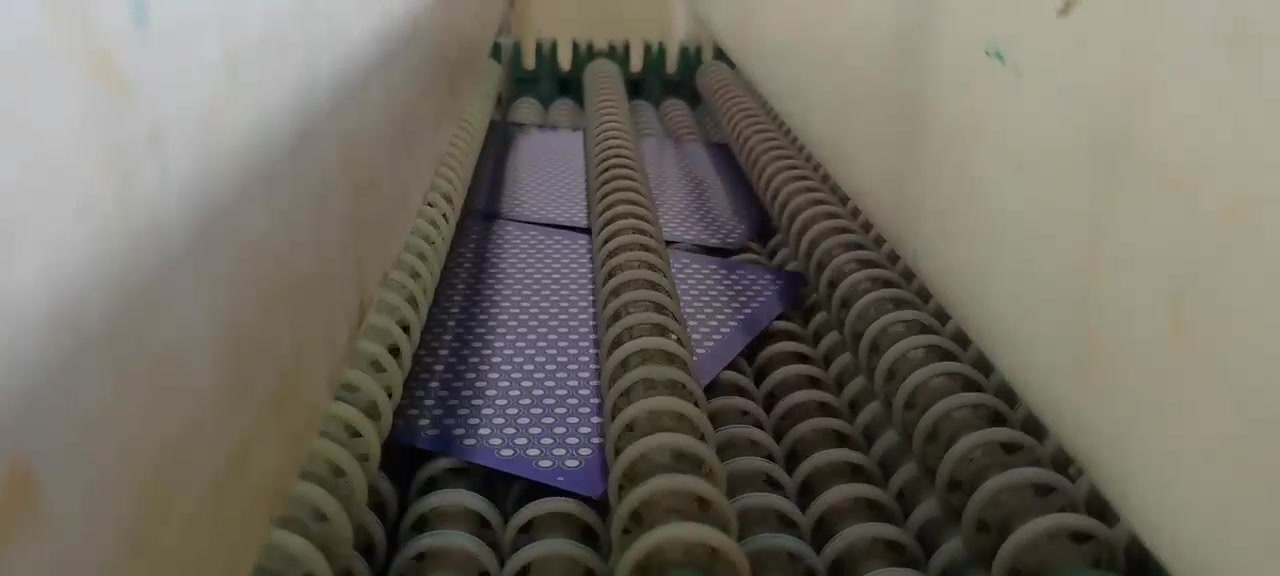
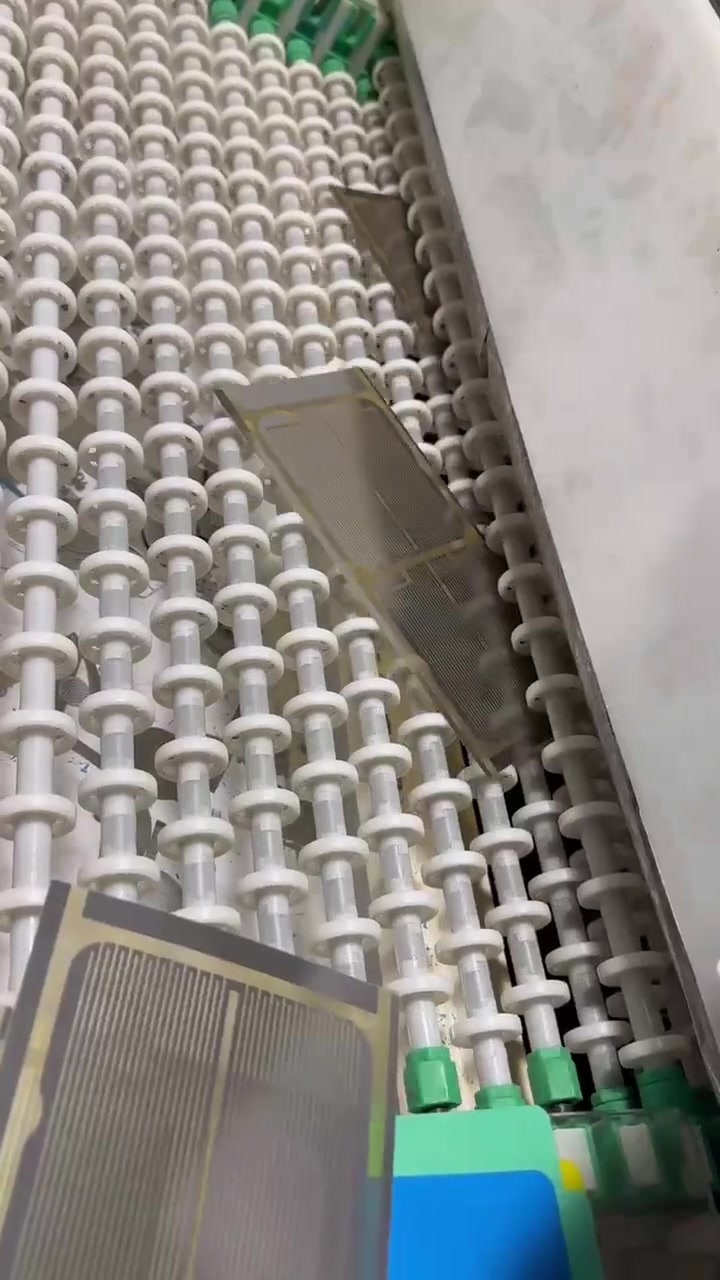
We have a full set of etching production equipment and mature processing technology. We can manufacture products in any shape with mesh sizes as small as 0.1mm, according to your requirements.


Our Advantage
Factory Direct Shipping
Our products undergo 100% QC checks before shipment, and we ensure compliance with international standards. If you require specific certifications for your target market, just let us know, and we'll meet those requirements.
Experienced Design and Manufacturing Team
We work closely with customers from the design phase to help avoid potential product flaws, ensuring both the functionality and design meet expectations.
Excellent Supply Chain Management
We can quickly adjust production schedules to meet your urgent deadlines, whether it's for large bulk orders or smaller rush orders.
OEM & ODM Support
We offer the option to print your logo or other customizations.
Strict Quality Control
Our products undergo 100% QC checks before shipment, and we ensure compliance with international standards. If you require specific certifications for your target market, just let us know, and we'll meet those requirements.
Certificate
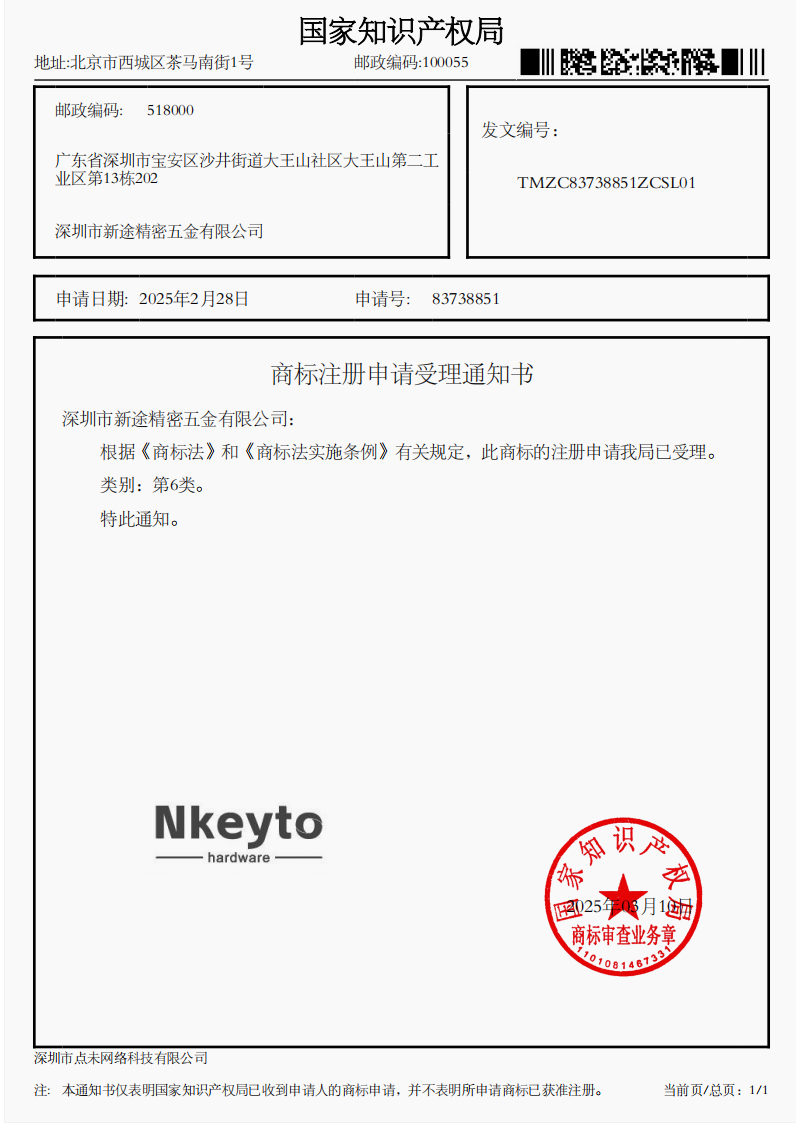
商标6类

9001
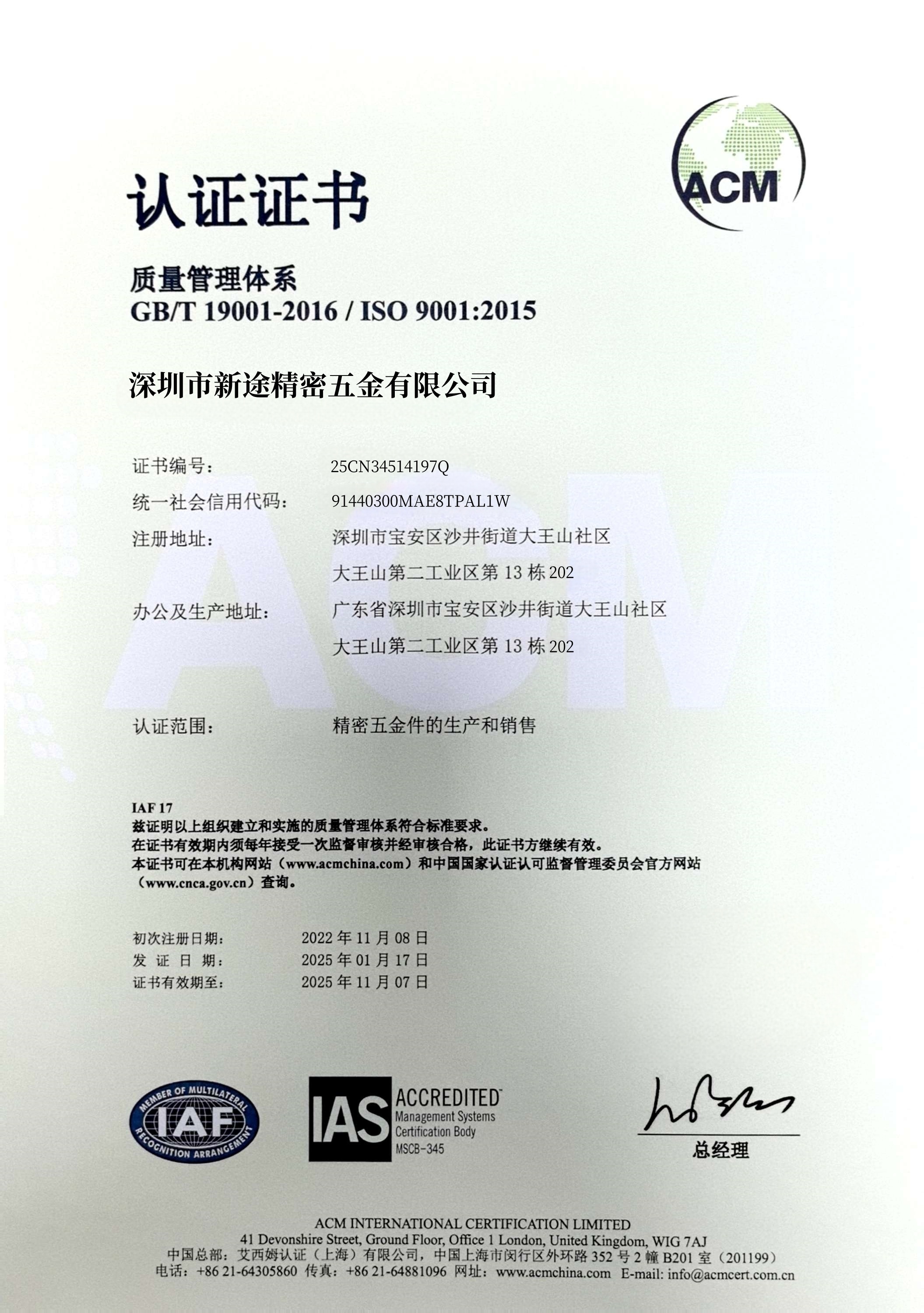
质量认证


Related Products

Shenzhen Nkeyto Precision Hardware Co., Ltd. is a factory specializing in precision hardware processing, committed to providing customers with high-quality products and services.We look forward to working with you.
Contact Us

E-mail: luna@nkeyto.com

Tel: +1 213-221-9094

Add: 13th Building, 202, Dawangshan Second Industrial Zone, Dawangshan Community, Shajing Street, Bao'an District, Shenzhen, Guangdong Province
Powered by: CEglobal
Copryright © 2025 Shenzhen Xintu Precision Hardware Co., Ltd.




Back To Top